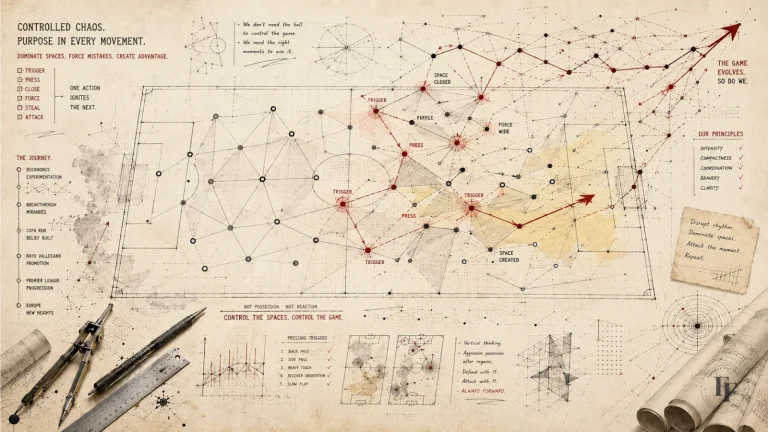

The Monumental Rise of AFC Bournemouth (Part 1): From Existential Crisis to the Premier League
The Ultimate Contrast
In the modern landscape of elite football, success is frequently dictated by historical wealth, commercial dominance, and vast stadium capacities. AFC Bournemouth stands as a profound exception to that rule. The journey of the South Coast club is a testament to what can be achieved when operational clarity, collective resilience, and brilliant tactical stewardship converge against seemingly impossible odds.
To fully grasp the magnitude of where Bournemouth stands today, one must examine the depth of where they began. Long before competing at the highest levels of the game, the club was trapped in a cycle of financial instability, structural decay, and existential peril. The transformation from a bankrupt lower-league outfit facing immediate extinction into an established top-flight institution is not merely a footballing story; it is one of the most remarkable operational turnarounds in modern sporting history.
The Structural Decay (2001–2008)
2001–2002: The Loss of Dean Court
The turn of the millennium brought catastrophic financial pressure to Dean Court. Facing mounting debts following the costly redevelopment of their home ground, the club’s board made the drastic decision to sell the stadium to a property management firm in an attempt to clear pressing liabilities. The move proved to be a disastrous financial misstep. Instead of securing long-term solvency, Bournemouth was forced into a leaseback agreement, incurring steep operational rent costs simply to play home fixtures.
This financial strain quickly bled onto the pitch. During the 2001/02 campaign, the club suffered relegation from the third tier to Division Three (now League Two). Competing in the fourth tier of English football severely curtailed matchday revenue, compounding the club’s growing financial distress.
2003–2006: Overextension and Systemic Failure
Though Bournemouth secured an immediate promotion back to the third tier at the first time of asking, the subsequent years were defined by severe budget mismanagement. In an aggressive pursuit of Championship football, the club stretched its wage structure beyond sustainable limits. Overspending on playing squad contracts left zero financial reserves for basic infrastructure, pitch maintenance, or travel expenses.
The consequences were swift:
- Player and staff wages routinely went unpaid.
- Squad depth evaporated as injuries mounted without funds to secure replacements.
- Promising campaigns collapsed under the weight of thin, overworked squads, resulting in two painful near-misses in the promotion play-offs.
2006–2008: Insolvency and the -10 Deduction
In late 2006, businessman Jeff Mostyn entered the club as a minority investor. Upon making his initial capital injection, co-investors withdrew their support, leaving Mostyn to uncover millions in hidden liabilities, unpaid taxes, and back wages. Mostyn repeatedly injected personal capital to keep the gates open, but the structural deficit was too severe to hold off insolvency indefinitely.
In February 2008, Bournemouth officially entered administration, triggering an automatic 10-point deduction from the Football League that guaranteed their relegation back to League Two. Worse was to follow. Due to technical failures by the new ownership group to properly negotiate a Company Voluntary Arrangement (CVA) to settle outstanding debts, the Football League penalized the club with an unprecedented 17-point deduction for the start of the 2008/09 season, alongside a strict, total transfer embargo.
Bournemouth was forced to accept these punitive conditions to avoid losing its Football League share entirely. The club was on the precipice of total liquidation.
The Turning Point & The Crucible (2008–2010)
2008–2009: The Bucket Collections and “The Great Escape”
Starting the 2008/09 League Two campaign on -17 points required a miracle simply to survive in professional football. Local supporters gathered on street corners with buckets outside Dean Court, raising spare change to pay matchday stewards, energy bills, and player travel. On the pitch, early results were disastrous. Manager Kevin Bond was dismissed after going winless in the opening four matches, and his replacement, Jimmy Quinn, lasted just 19 games before being relieved of his duties with the club firmly entrenched in the relegation zone.
On New Year’s Eve 2008, the board appointed former Cherries defender Eddie Howe as caretaker manager. At just 31 years of age, Howe became the youngest manager in the Football League, having never previously managed at senior level.
Despite losing his first two matches in charge, Howe quickly transformed the internal culture of the squad. He weaponized the 17-point penalty, fostering a fierce internal bunker mentality.
Howe executed several decisive operational moves:
- Cultural Leadership: He brought veteran forward Steve Fletcher back into a central role, instilling physical leadership and belief in the dressing room.
- Defensive Rigidity: Restricted by the transfer embargo, Howe overhauled training methods, transforming a porous backline into a disciplined, organized defensive unit.
- Data-Driven Preparation: Howe introduced meticulous video analysis and high-tempo training drills uncommon in the fourth tier.
The results were astonishing. Having taken just 24 points from their first 23 games under previous management, Bournemouth collected 39 points in the second half of the season under Howe. On April 25, 2009, a late goal from Steve Fletcher secured a dramatic 2-1 victory over Grimsby Town, securing League Two safety with a game to spare. Without the 17-point penalty, Howe’s side would have finished 11th in the table.
2009–2010: The Embargoed Promotion
With the transfer embargo still enforced through early 2010, Howe was forced to enter the 2009/10 campaign with the exact same playing squad. What initially appeared to be a handicap became a massive competitive advantage. The shared trauma of the previous season created an elite level of squad cohesion and tactical familiarity.
Howe shifted the team’s tactical focus from defensive stability to an expansive, high-pressing attacking system. Forward Brett Pitman thrived under this mandate, scoring 26 league goals. Supported by a passionate home crowd that turned Dean Court into a fortress, Bournemouth won 8 of their opening 10 matches.
They finished the season as League Two runners-up, securing automatic promotion to League One. In less than 18 months, Howe had taken a bankrupt club from the brink of non-league oblivion into the third tier of English football.
The Funded Ascent (2011–2015)
2011–2013: Institutional Investment and Structural Stability
After establishing the club in League One and reaching the play-offs in 2011, a transformative off-field event took place. Russian businessman Maxim Demin acquired a 50% stake in AFC Bournemouth in late 2011. Following a brief period where Howe departed for Burnley before returning to his spiritual home in October 2012, Demin bought out remaining shareholder Eddie Mitchell in September 2013 to become sole owner, appointing Jeff Mostyn as chairman.
Demin’s involvement provided immediate financial stability. He quietly cleared the club’s historical debts and underwrote strategic investments in player recruitment, while leaving all football operations entirely in the hands of Howe and his staff.
With elite operational backing, Bournemouth stormed to automatic promotion from League One at the end of the 2012/13 season, finishing second with a league-high 76 goals scored.
2014–2015: Championship Dominance
Entering their second season in the Championship in 2014/15, Howe refined the squad with targeted additions, most notably signing striker Callum Wilson from Coventry City. Wilson’s explosive pace and clinical finishing provided the central threat for Howe’s fluid, possession-based 4-4-2 system.
After a steady start to the campaign, Bournemouth hit an incredible run of form, going 13 matches undefeated midway through the season. Playing an attractive style characterized by rapid wide combinations, overlapping full-backs, and relentless pressing, the Cherries stunned the division.
On April 27, 2015, a 3-0 home victory against Bolton Wanderers effectively sealed their rise, followed by a final-day win at Charlton Athletic that crowned AFC Bournemouth as Championship winners with 90 points.
For the first time in their 116-year history, the club from the South Coast had reached the top flight of English football.
This concludes Part 1 of the series. Part 2 will cover The Stabilization & The Reset (2015–2022) through to the Corporate Masterclass & European Dawn (2022–Present).
// Two-part Feature
Club Study
Continue to Part 02 →
Part 2: Institutional Modernization and the European Era
How institutional agility transformed a seaside club into an established top-flight entity.
(Un)laced
A curated look at the moments that mattered alongside stories and insights worth your time.