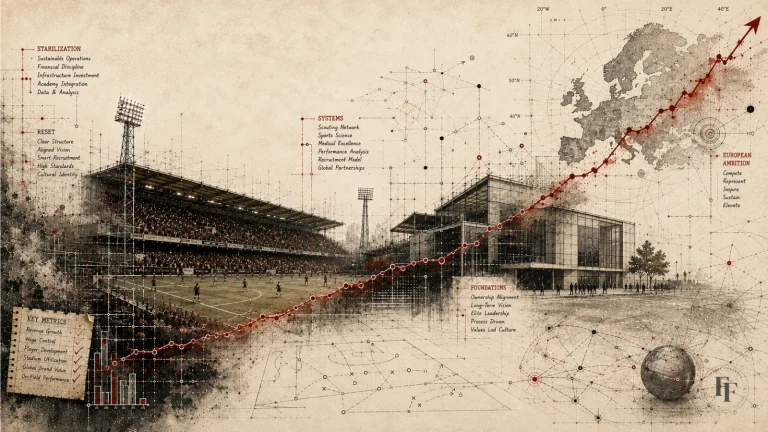

Ascension and Adaptation: How Promoted Clubs Remain in the Premier League
Each summer, the arrival of three newly promoted clubs brings fresh energy, compelling storylines, and structural recalibration to the Premier League. The system of promotion and relegation, established during the founding seasons of the English Football League in the late 19th century, remains the defining competitive meritocracy of the game. Clubs earning promotion to the top flight have done so through a grueling, 46-game marathon or the pressure cooker of the playoffs. They arrive not by chance, but by merit, and deserve to be treated as legitimate competitors from day one.
Ascending to the top tier fundamentally alters a club’s trajectory. The Premier League provides an unmatched global platform, allowing clubs to attract elite talent that would otherwise be out of reach. In turn, players gain the ultimate stage to showcase their skills, creating a mutually beneficial ecosystem where athletic performance drives financial value and transfer profit. To maximize this dynamic, however, a club must first persuade prospective signings of its long-term ambition. Recruitment is not merely an operational task. It is the primary engine of top-flight survival.
The Architecture of Survival
For any newly promoted side, the initial season in the top tier is defined by a singular objective: survival. Achieving that baseline requires a deliberate balance of youthful energy and seasoned Premier League experience. Squad composition must feature battle-tested veterans who understand the technical demands of the league and can guide younger teammates through inevitable periods of adversity.
On the pitch, survival requires elite efficiency. Top-flight opposition rarely grant second chances, making clinical execution in the final third non-negotiable. Teams must cultivate a ruthless edge in front of goal while maintaining a disciplined defensive posture, striking a careful balance between fearlessness and tactical restraint. Overcommitting to attacking phases can leave a team exposed to catastrophic counter-attacks.
Historically, targeting a minimum threshold of 40 points has served as the universal benchmark for securing top-flight status. Establishing this numerical target gives a squad a clear, measurable objective. Once that baseline is secured, a club can shift its sights toward grander ambitions, much like Leicester City did during their historic 2015/16 campaign when a battle for survival transformed into an extraordinary title run. Reaching this safety mark fosters a genuine sense of belonging. To maintain momentum, clubs must block out external noise and remain singularly focused on their own process rather than relying on the missteps of rivals.
The 5 Pillars of Top-Flight Stability
Maintaining Premier League status over an extended period requires a structural framework founded on five core operational and tactical pillars.
Adaptability
Transitioning from the Championship to the Premier League requires an immediate adjustment to the speed of play. In the top tier, tactical execution is fluid and rapid. Strikers are expected to initiate pressing schemes, wingers track back to form low blocks, and team structures move fluidly up and down the pitch as a single cohesive unit to compress space and deny passing lanes.
Beyond open play, adaptability extends to mastering set-piece efficiency, navigating the nuances of Video Assistant Referee (VAR) protocols not present in the second tier, and respecting the sheer scale of top-flight competition. Fluidity in game management is essential; rigidity in tactical planning often leads to swift punishment.
Consistency
Sustaining top-flight status demands a high level of performance across a 38-game calendar. Consistency relies on unwavering adherence to the manager’s tactical framework, preserving defensive organization, and minimizing structural errors. Rather than relying on sporadic moments of individual brilliance, successful sides establish their foundation on reliable, repeatable patterns of play that hold up under pressure.
Flexibility
While consistency establishes a baseline, tactical flexibility dictates match-to-match survival. Promoted clubs must remain comfortable shifting their approach based on the opponent, often ceding possession to preserve structural integrity for extended periods. Relinquishing the ball is not a concession of defeat, but a calculated ploy to set up rapid counter-attacks. In the top flight, recognizing that securing a single point is always superior to risking zero is a hallmark of tactical maturity.
Mentality
Where lower-division football often relies on physical attrition, the Premier League demands tactical control, tempo management, and psychological resilience. Maintaining a clear, unwavering mindset prevents a squad from collapsing when results go against them.
Given that roughly 10 to 13 percent of all Premier League goals are scored during second-half stoppage time, mental sharpness until the final whistle is vital. Arriving at every fixture fully prepared, respecting the opposition, and maintaining emotional poise under pressure are the ultimate catalysts for long-term survival.
Recruitment
The Premier League is defined by elite athleticism and rapid spatial execution. While physical demands in the lower divisions are intense, the top tier accelerates decision-making time. Consequently, recruitment strategies can define a season before kickoff.
A successful transfer strategy prioritizes structural balance, blending top-tier experience with high-ceiling talent. Recruitment should directly target thin positional groups and mitigate depth vulnerabilities through permanent signings or strategic loan deals. Reinforcing the defensive spine must take precedence, as a leaky defense renders even the most potent attack ineffective. Finally, squad additions must be measured. Overhauling a roster too aggressively risks destroying the core locker room chemistry that earned promotion in the first place.
Models of Modern Endurance
Several clubs have successfully executed this model, proving that promoted sides can establish long-term roots in the top flight.
Brentford FC
Promoted to the Premier League for the first time ahead of the 2021/22 season, Brentford has established a masterclass in data-driven recruitment and structural resilience. Despite regularly losing key performers to larger clubs, their analytical scouting model consistently identifies high-impact replacements, allowing them to remain a formidable opponent for the league’s elite.
Brighton & Hove Albion FC
Since making their Premier League debut in 2017/18, Brighton has developed into one of the most structurally sound clubs in Europe. Their ability to identify undervalued talent globally has created a flexible, self-sustaining model that has yielded top-half finishes and European qualification.
AFC Bournemouth
Following their return to the top flight in 2022/23, Bournemouth has undergone a remarkable tactical evolution. Through intelligent recruitment and an adaptable pressing style, the club has transformed into a progressive, top-tier side capable of competing with the league’s top half. This upward trajectory culminated in their first-ever European qualification.
Crystal Palace FC
Following their promotion in 2013, Crystal Palace demonstrated incredible grit to establish themselves as permanent Premier League fixtures. That long-term stability laid the groundwork for historic cup runs, resulting in an FA cup triumph against Manchester City in 2025, a Community Shield victory against Liverpool in the same year, and finally crowned UEFA Conference League champions in 2026.
Sunderland AFC
Serving as the most recent template, Sunderland satisfied all five criteria in a single campaign following their 2025 promotion. Constructed around a balanced squad, clear tactical flexibility, and an unshakeable mentality, they bypassed the standard survival battle entirely to secure qualification for the UEFA Europa League in their first season back.
The Cycle Begins Anew
The journey from the Championship to the Premier League remains one of the most demanding transitions in modern sport. While the financial rewards and global visibility are vast, the gap in tactical speed and technical execution requires immediate adaptation. As a new campaign begins and three fresh clubs take their place in the top flight, a familiar question emerges: which of the newcomers possess the structural clarity, recruitment precision, and mental fortitude required to endure?
(Un)laced
A curated look at the moments that mattered alongside stories and insights worth your time.