Rivalries We Miss: Aston Villa vs Birmingham City
The Forge of the Second City Derby
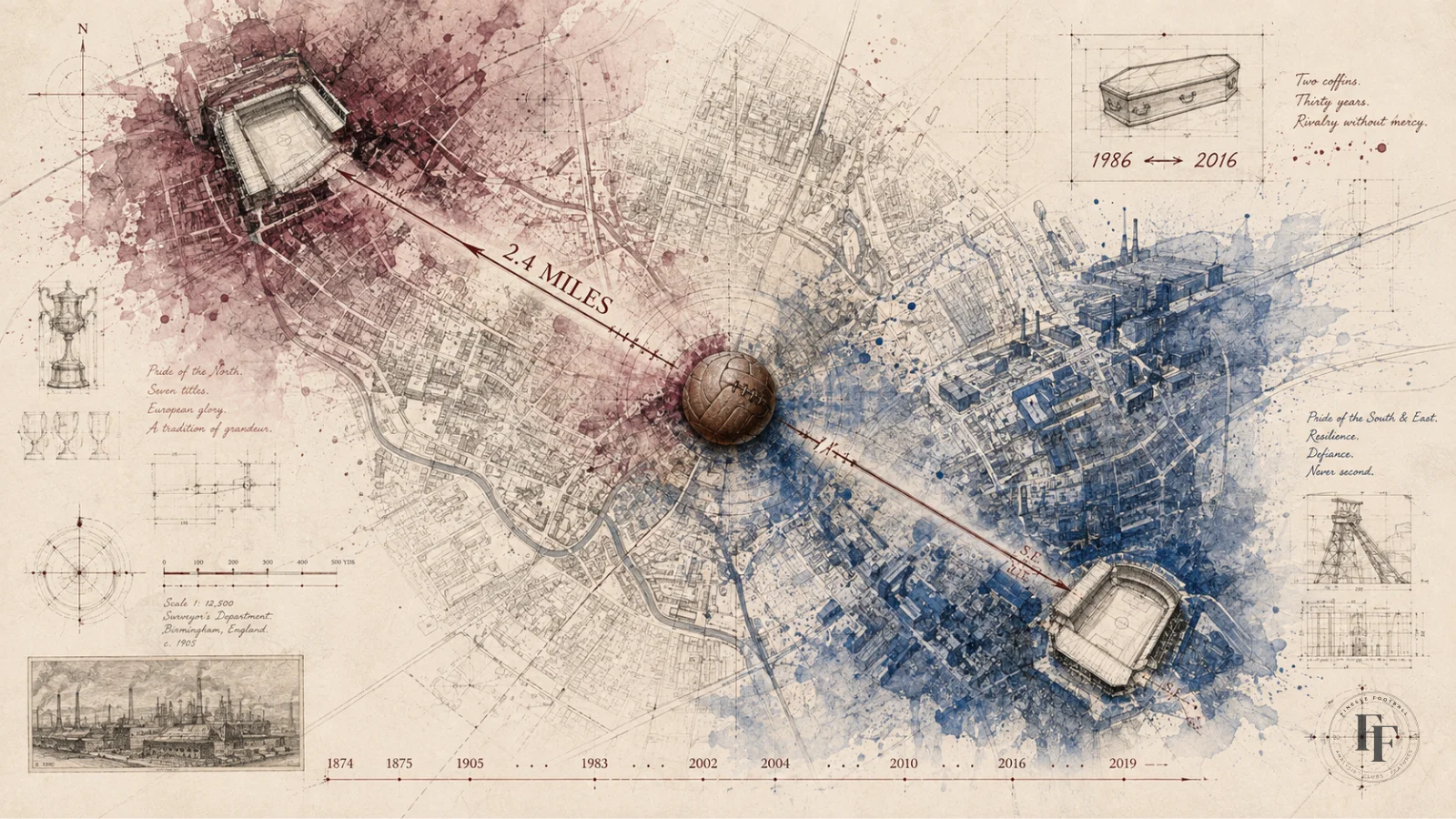
Separated by just 2.4 miles of industrial heartland, Aston Villa and Birmingham City have produced one of the most fiercely contested fixtures in English football. Historically recognized as the Second City derby due to Birmingham’s stature as the nation’s secondary industrial hub, the rivalry has been entirely absent from the fixture calendar since 2019. Eight years of divisional separation have left a void in West Midlands football, pausing a competitive friction that dates back to the 19th century.
Across 127 official competitive meetings, Aston Villa hold the historical edge with 57 victories to Birmingham City’s 38, alongside 32 drawn matches. Their last encounter took place during the 2018/19 Championship season, a campaign that ultimately concluded with Villa gaining promotion back to the Premier League while Blues remained in the second tier.
| Club | Played | Victories | Draws | Losses |
|---|---|---|---|---|
| Aston Villa | 127 | 57 | 32 | 38 |
| Birmingham City | 127 | 38 | 32 | 57 |
The Origins of Friction and Cultural Divergence
Aston Villa were formed in 1874 in the district of Aston, followed a year later by the establishment of Small Heath Alliance in 1875. Local history notes an unwritten agreement between the founding directors that neither entity would incorporate the city’s name to maintain neutrality. However, Small Heath Alliance broke this pact in 1905 by rebranding as Birmingham Football Club, eventually adopting Birmingham City FC in 1943. The unilateral appropriation of the city’s name drew sharp criticism from Villa supporters, establishing an institutional tension that persisted over subsequent generations.
Geography reinforced this structural split, dividing the city cleanly between Villa supporters in the north and Birmingham faithful in the south and east.
This territorial boundary shaped contrasting club identities. Villa’s cabinet of 27 major honors, including seven top-flight league titles and a European Cup, fostered an expectation of elite stature. Conversely, Birmingham City’s traditional identity grew out of resilience and defiance, backed by a supporter base that often viewed their neighbor’s outlook as overly entitled. By the late 20th century, this socio-cultural divergence migrated into organized supporter groups, leading to frequent physical confrontations between rival elements surrounding matchdays.
Historical Flashpoints and Unforgettable Encounters
The Battle of 1983
During a heated First Division fixture in November 1983, Aston Villa took a 1-0 lead before the match devolved into chaos. Following a disallowed goal and a missed penalty for Birmingham striker Noel Blake, the contest degenerated into violent challenges across the pitch. Refereeing officials awarded over 50 free kicks and issued multiple bookings. The match reached its boiling point after the final whistle, when Blake headbutted Villa defender Steve McMahon on the pitch, summarizing the volatility of the era.
The Relegation Coffin Rituals (1986 & 2016)
When Birmingham City were relegated from the First Division in the 1985/86 season, a contingent of Villa supporters constructed a life-sized coffin decorated in royal blue, carrying it down Garrison Lane to St Andrew’s to mark the competitive fall of their rivals. Thirty years later, Birmingham supporters delivered a calculated response. Following Villa’s relegation from the Premier League in 2016, travelling Blues fans carried a claret and blue casket to their away fixture at Huddersfield, conducting a mock procession to mark Villa’s exit from the top flight.
The Enckelman Deflection (2002)
In September 2002, the two clubs met at St Andrew’s for their first Premier League derby in 15 years. With Birmingham leading 1-0 in the 77th minute, Villa defender Olof Mellberg executed an uncontested throw-in toward his goalkeeper, Peter Enckelman. The Finnish international misjudged the rolling ball, which passed under his boot and into the net. The match official ruled that the ball had grazed Enckelman’s footwear before crossing the line, awarding the goal to Birmingham. The moment was exacerbated when a pitch invader confronted Enckelman on the field, before Geoff Horsfield added a third goal to seal a 3-0 victory for the home side.
The Stoppage-Time Equalizer (2004)
Aston Villa held a 2-1 lead deep into stoppage time at Villa Park in February 2004, following goals from Darius Vassell and Thomas Hitzlsperger. In the 94th minute, a long clearance into the penalty box caused panic in the Villa defense, allowing Blues substitute Stern John to fire home an equalizer with seconds remaining. The late goal prompted intense celebrations along the touchline, where Birmingham manager Steve Bruce celebrated directly in front of the Villa bench, triggering a heated confrontation between both coaching staffs that required intervention from match officials.
The League Cup Quarter-Final (2010)
A December 2010 League Cup quarter-final at St Andrew’s saw Birmingham secure a 2-1 victory courtesy of an 84th-minute winner from Nicola Žigić. Upon the final whistle, over a thousand home supporters invaded the pitch, advancing toward the visiting supporter section. Projectiles and seats were exchanged across security barriers, with disorder subsequently spilling into surrounding streets. The incident resulted in 27 injuries and prompted widespread public condemnation from civic authorities and footballing bodies.
Jack Grealish: Pitch Invasion and Match Winner (2019)
During a Championship meeting at St Andrew’s in March 2019, Villa captain Jack Grealish was struck from behind by a pitch invader less than ten minutes into the match. Grealish remained on the field after security removed the intruder. In the 67th minute, the midfielder collected the ball on the edge of the penalty area and scored the match-winning goal, securing a 1-0 victory before celebrating in front of the away support.
Crossing the Divide: Direct Transfers and Coaching Swaps
Direct movement between the two clubs remains one of the rarest events in West Midlands football, with both playing and coaching staff facing immediate pushback upon switching allegiances.
The Managers Who Swapped Benches
Ron Saunders
Nine months after guiding Aston Villa to the 1980/81 First Division title, Ron Saunders resigned following a contractual dispute with the board. In February 1982, he accepted the managerial role at Birmingham City. His cross-city move added intense personal focus to subsequent derbies, culminating in a 2-1 victory over Villa in 1983.
Alex McLeish
After leading Birmingham City to League Cup success in February 2011, Alex McLeish suffered relegation to the Championship three months later. He submitted his resignation via email in June 2011 and was confirmed as Aston Villa manager five days later. The appointment generated immediate fan protests at Villa Park, and McLeish was relieved of his duties after 11 months following a 16th-place finish.
Steve Bruce
Steve Bruce spent six years managing Birmingham City from 2001 to 2007, earning two promotions to the Premier League. Nine years later, in October 2016, he took charge of Aston Villa with the club in the Championship. Despite guiding Villa to the 2018 play-off final, Bruce faced persistent resistance regarding his past affiliation, leading to a volatile split with supporters in October 2018.
Player Crossovers: Villa to Birmingham
Harry Hampton
As Villa’s record league goalscorer with 242 goals in 376 appearances, Hampton transferred to Birmingham in 1920 after returning from service in World War I. Despite sustained war injuries, he finished as Birmingham’s top scorer and helped them secure the Second Division title, earning rare respect from both fanbases.
Liam Ridgewell
Liam Ridgewell became the first player in 24 years to move directly between the clubs when he completed a transfer from Villa to Birmingham in 2007. The academy product became a central component of Birmingham’s defense over five seasons, eventually winning the 2011 League Cup.
Craig Gardner
An Aston Villa academy graduate and self-professed Birmingham City supporter, Craig Gardner completed a transfer to St Andrew’s in January 2010. The midfielder established himself quickly in Birmingham’s starting lineup, while his departure created lasting frustration among Villa supporters due to his previous academy ties.
Player Crossovers: Birmingham to Villa
Charlie Athersmith
Having won five First Division titles and two FA Cups with Villa during the 1890s, Athersmith transferred to Birmingham in 1901 following a dispute with the Villa board. After a single season at St Andrew’s, he engineered a return to Villa in 1902, drawing criticism from Birmingham supporters who viewed the brief tenure as leverage.
Alan Curbishley
Midfielder Alan Curbishley spent four seasons at Birmingham, playing over 130 matches and securing promotion in 1980. Following a dispute with manager Ron Saunders in 1983, he transferred directly to reigning European champions Aston Villa, leaving Birmingham mid-season during a relegation battle.
Jota Peleteiro
Spanish playmaker Jota moved from Birmingham to Aston Villa in July 2019, breaking a 36-year drought for direct player transfers from Blues to Villa. The transaction involved a swap arrangement that saw Gary Gardner move permanently to St Andrew’s in the opposite direction.
The Void in the West Midlands Calendar
The Second City derby represents a raw form of competitive friction that cannot be artificially duplicated. Unlike derby fixtures defined purely by modern league standings or temporary title races, the dynamic between Aston Villa and Birmingham City is built on genuine geographic proximity, contrasting civic histories, and over a century of localized tension.
Without regular league encounters since 2019, West Midlands football lacks its central fixture. Until divisional alignment or domestic cup draws pair the two clubs again, the Second City derby remains the Premier League era’s most notable missing fixture.
(Un)laced
A curated look at the moments that mattered alongside stories and insights worth your time.