The Geometry of Judgment: Why Technology Cannot Solve Law 11
Ever since Video Assistant Refereeing was introduced to the Premier League for the 2019/20 season, it has operated under constant scrutiny. While subsequent technical refinements have smoothed out routine decisions, incidents like the September 2026 Manchester derby prove that VAR remains far from a finished product.
The immediate post-match debate following Manchester City‘s victory centered on a familiar scenario. Supporters and pundits initially questioned whether Erling Haaland had drifted into an offside position before turning in Joško Gvardiol’s cross. Semi-automated tracking quickly confirmed that Haaland was legally positioned, but the genuine refereeing puzzle involved Enzo Fernández.
Standing in an offside position, Fernández made a sudden, aggressive movement toward Gvardiol’s delivery without touching it. His dummy run occurred in immediate proximity to Manchester United center-back Lisandro Martínez, raising a much harder tactical question of whether Fernández’s action compromised Martínez’s ability to attack the ball.
The VAR team determined that Fernández had not interfered sufficiently to commit an offense, allowing Haaland’s goal to stand. Pro Ref later acknowledged that validating the goal involved an error in judgment. The refereeing body clarified that VAR should have instructed referee Michael Oliver to consult the pitchside monitor to evaluate Martínez’s reaction firsthand. Following the post-match review, VAR Matt Donohue and assistant VAR Blake Antrobus were pulled from the upcoming round of Premier League appointments.
Law 11 does not require physical contact for an offense to take place. The sequence highlighted a reality often obscured by line-drawing technology: offside has never been a purely geometric calculation.
The Active Conditions of Law 11
Under the IFAB Laws of the Game, occupying an offside position is not an offense in itself. An attacking player can linger behind the deepest defender without violating any rule. An offense occurs only when that player becomes actively involved in the phase through specific, defined criteria.
| DIRECT CONTACT | Playing or touching a ball passed by a teammate. |
| PHYSICAL OBSTRUCTION | Clearly obstructing an opponent’s line of sight or challenging for the ball. |
| TACTICAL IMPACT | Making an obvious action that clearly affects an opponent’s ability to play the ball. |
While making direct contact with the ball represents the most obvious violation, Law 11 explicitly penalizes non-contact interference. An offside attacker commits an offense if they attempt to play a nearby ball in a manner that impacts an opponent, or if their movement forces a defender into an unnatural reaction.
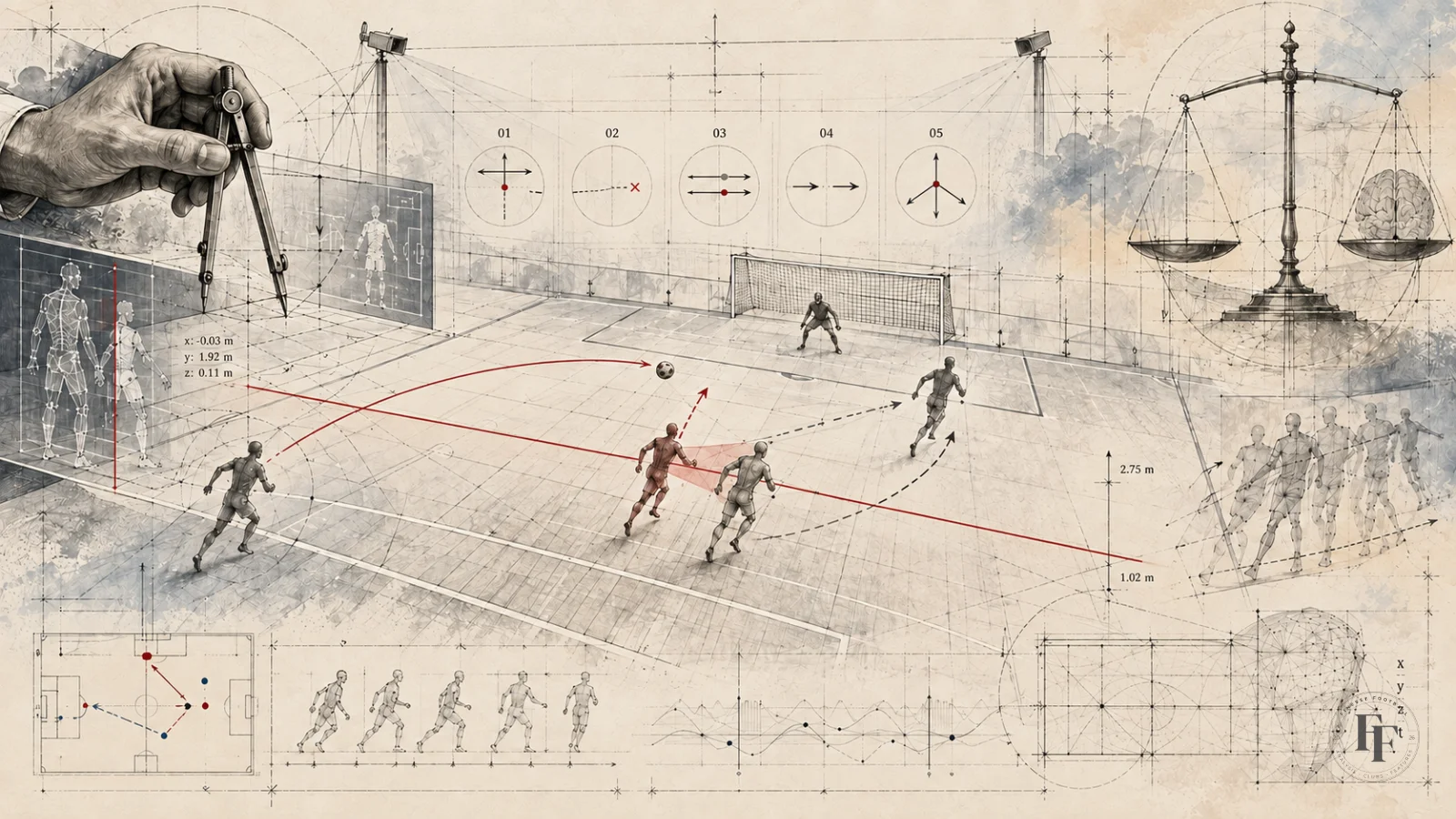
Determining whether Fernández breached Law 11 was not a matter of plotting spatial coordinates on a pitch grid. It required human officials to evaluate proximity, body language, defensive momentum, and competitive consequences. Technology identifies physical positioning, but match officials must determine what that positioning means in real time.
Five Paradigms of Officiating Failure
Examining the history of Premier League VAR reveals that officiating errors break down into distinct operational categories. These high-profile missteps illustrate that optical precision addresses only a fragment of the decision-making process.
| Match & Date | Failure Type | Core Mechanic |
|---|---|---|
Man City vs Villa Jan 2021 | Interpretation | Unclear rule application following deliberate play. |
Arsenal vs Brentford Feb 2023 | Procedural | Failure to execute the offside line check on the relevant secondary attacker. |
Brighton vs Palace Feb 2023 | Application | Offside lines drawn against the wrong defender. |
Spurs vs Liverpool Sep 2023 | Communication | Correct review outcome communicated incorrectly to the on-field referee. |
Manchester Derby Sep 2026 | Subjective Judgment | Failure to evaluate non-contact interference on a defending player. |
1. Interpretation: Manchester City vs. Aston Villa (January 2021)
With the match goalless, Rodri moved back from an offside position just as Aston Villa center-back Tyrone Mings chest-controlled a high ball. The moment Mings brought the ball under control, Rodri challenged him from behind, won possession, and initiated the attack that led to Bernardo Silva’s opening goal. Match officials allowed the goal, reasoning that Mings’s deliberate touch reset the offside phase.
The call generated substantial debate because Rodri gained a distinct tactical advantage directly from his original offside position. Following consultations with IFAB and UEFA, PGMOL updated its guidance to clarify that similar challenges must be blown dead for offside. This was a clear failure of interpretation. The technology functioned and all parties agreed on player locations, but officials misjudged how Law 11 should apply following a deliberate touch by a defender.
2. Procedural Execution: Arsenal vs. Brentford (February 2023)
During a 1-1 draw at the Emirates, Ivan Toney scored a second-half equalizer for Brentford. VAR official Lee Mason spent several minutes reviewing an earlier secondary phase involving Ethan Pinnock. However, he completely omitted checking Christian Nørgaard, who was standing offside before delivering the decisive cross.
PGMOL subsequently issued a formal apology acknowledging the oversight. Mason was removed from upcoming match appointments before eventually parting ways with PGMOL by mutual consent. This represented a procedural failure. The technology was fully capable of supplying the correct answer, but the official running the review skipped a fundamental step in the checking protocol.
3. Application: Brighton & Hove Albion vs. Crystal Palace (February 2023)
That same weekend, Pervis Estupiñán appeared to score for Brighton against Crystal Palace before VAR ruled the goal out for offside.
The software operated correctly, but the VAR technician manually anchored the calibration line to Palace defender James Tomkins, missing the fact that Marc Guéhi was positioned deeper. Had the line been drawn against Guéhi, Estupiñán would have been ruled onside. PGMOL issued an apology to Brighton for an application failure, where an objective tool rendered an incorrect outcome because a human official selected the wrong reference point.
4. Communication: Tottenham Hotspur vs. Liverpool (September 2023)
With Spurs and Liverpool locked at 0-0, Luis Díaz scored for Liverpool but was flagged offside by the assistant referee. VAR Darren England reviewed the sequence and correctly determined that Díaz was onside.
Believing the on-field call had been a goal, England confirmed the review by stating “check complete.” That phrasing unintentionally validated the assistant referee’s offside call. By the time the VAR suite realized the error, play had resumed, and protocol prevented officials from halting the match to award the goal. PGMOL released the review audio days later, laying bare a communication breakdown where officials reached the correct decision but conveyed it incorrectly.
5. Subjective Judgment: The Manchester Derby (September 2026)
Unlike missed procedural steps or communication breakdowns, the September 2026 derby incident hinged entirely on subjective evaluation. Modern tracking cameras instantly established the spatial coordinates of Haaland and Fernández. The breakdown occurred in evaluating the physical effect of Fernández’s movement on the defending structure.
| MEASURABLE BY TECHNOLOGY | Spatial coordinates, frame freeze, limb mapping, release point. |
| REQUIRES HUMAN JUDGMENT | Intention, distraction, line of sight, physical impact on defenders. |
The Limits of Automation
Premier League tracking infrastructure has reached an exceptional level of spatial precision. High-frame-rate camera arrays can locate a player’s shoulder, knee, or boot down to the millimeter within seconds. Yet no algorithm can quantify human intent or calculate defensive disruption.
Deciding whether an attacker made a clear attempt at the ball, whether that movement altered a defender’s recovery run, or whether it compromised a goalkeeper’s line of sight requires contextual analysis. Law 11 relies on qualitative standards, incorporating terms such as clearly attempts, impacts, obvious action, and clearly affects.
Technology provides officials with high-definition visual evidence, but human beings must interpret what that evidence means within the flow of play. Expecting automated systems to remove all controversy from Law 11 misunderstands the design of the rulebook. Offside positioning is a matter of spatial geometry, but offside interference will always remain a matter of human judgment.
(Un)laced
A curated look at the moments that mattered alongside stories and insights worth your time.