Out of the Abyss: Sunderland’s Triumphant Return
In the wake of a transformative new era, Sunderland AFC has reignited a dormant spark at the highest level of English football. Long recognized as a resilient and structurally disciplined side, the club built its reputation on a foundation that made them relentlessly difficult to break down. Historically comfortable yielding possession to construct patient, lethal counter-attacks, Sunderland focused on denying space and physical dominance to limit direct routes to their goal.
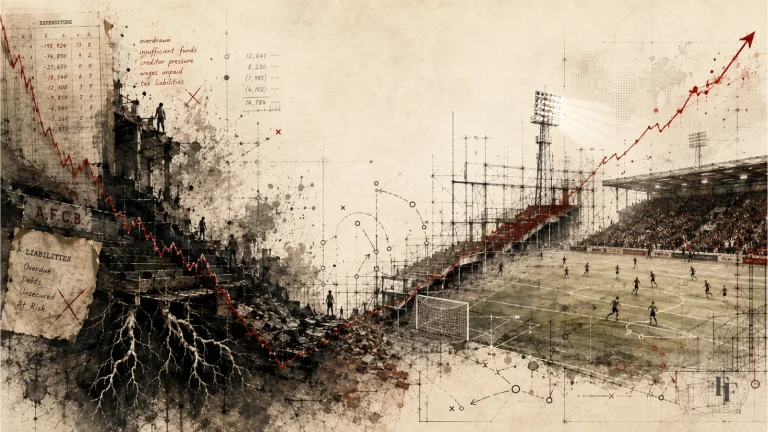
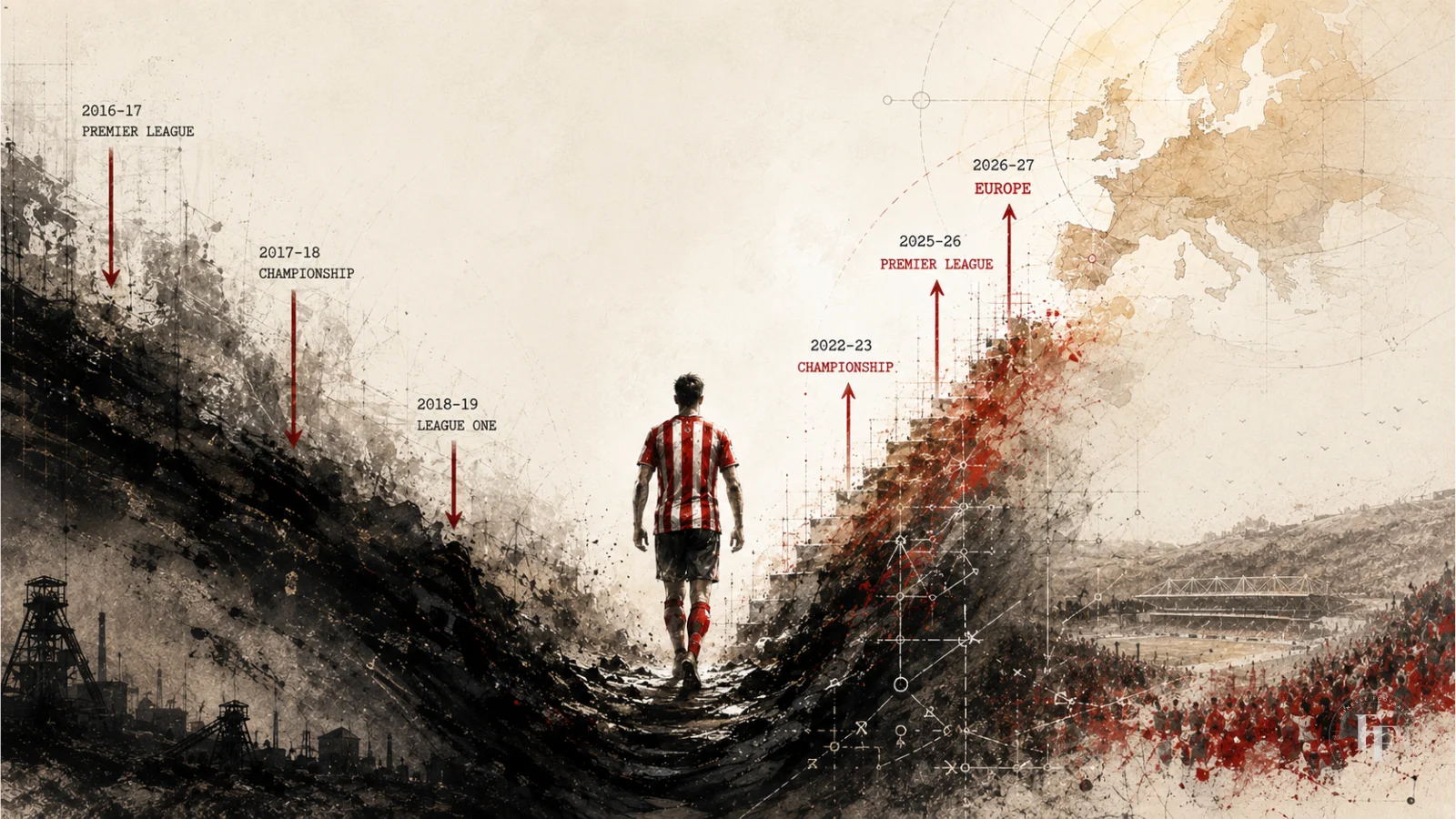
That structural identity, however, was severely tested during a precipitous fall. Relegated from the Premier League at the bottom of the table in 2017, the club suffered back-to-back drops into the third tier. What followed was a deliberate, eight-year battle through the football pyramid. After earning their way back to the Championship and eventually securing promotion back to the Premier League at the end of the2024/26 cycle, Sunderland did not merely fight to survive. In their very first season back in the top flight, they exceeded all expectations by remaining remarkably stubborn to play against and securing qualification for European competition. Through a complete squad overhaul, strategic recruitment, and cohesive leadership, a club once defined by a rapid decline has established itself as an absolute force.
Historical Foundation: Roots of Discipline and Distinction
Like many storied clubs in English football, Sunderland’s origins trace back to humble beginnings. Founded in 1879 as Sunderland and District Teachers A.F.C., the institution was built on principles of discipline, patience, and collective instruction. A year after its inception, the club opened its doors to non-teachers, shortening its name and laying the groundwork for a side that would eventually earn the moniker “The Team of All the Talents.” By 1895, following their third English league title, Sunderland defeated Scottish champions Hearts in a historic challenge match, leading contemporaries to crown them “Champions of the World” during an era when England and Scotland were the unquestioned pioneers of the game.
That early appetite for success established a legacy that continued across generations. Sunderland remains one of only three clubs since 1973 to win the FA Cup while competing outside the top flight, a testament to their deep-rooted big-match mentality. Decades later, during the 1998/99 campaign, they set a second-tier record by accumulating 105 points to secure promotion, a staggering benchmark that stood for over a quarter of a century before being eclipsed by Birmingham City in League One. Supported by a passionate fanbase that once set record attendances exceeding 75,000 at Roker Park in 1933, the club’s history has always been defined by scale, ambition, and an enduring connection to its community.
The Sinking Ship and the Pyramid Grind
The road back to stability was neither brief nor straightforward. Sunderland’s fall from the top tier ushered in an eight-year exile marked by rapid collapse and grueling rebuilds. The descent reached its lowest point during the 2017/18 Championship season, a brutal campaign in which the team managed just seven wins from 46 matches and conceded 80 goals, resulting in immediate relegation to League One.
What followed was a four-year stint in the third tier that tested the patience of the entire institution. A near-miss in their first League One season ended in heartbreak with a 2-1 playoff final loss to Charlton Athletic. The subsequent campaign saw them fall short of the playoffs entirely on goal difference after a sharp drop in attacking efficiency. Though goalscoring recovered in their third year, a playoff semi-final exit to Lincoln City prolonged the stay. Relief finally arrived in their fourth season when a fifth-place finish culminated in a decisive 2-0 playoff final victory over Wycombe Wanderers, ending their third-tier exile and restoring Championship status.
The climb through the Championship required similar persistence. In their first year back, a sixth-place finish led to a narrow 3-2 aggregate playoff loss to Luton Town. The emotional toll carried into a turbulent 2023/24 season where the team slid to 16th in the table. Over a span of tumultuous years featuring 19 managerial changes, structural continuity remained elusive until the appointment of head coach Régis Le Bris in July 2024. Under Le Bris, the trajectory shifted immediately. Sunderland navigated a demanding 2024/25 campaign to finish fourth, conquered Coventry City over two legs in the semi-finals, and sealed their Premier League return with a dramatic victory over Sheffield United at Wembley.
The Premier League Return: Blueprint for Success
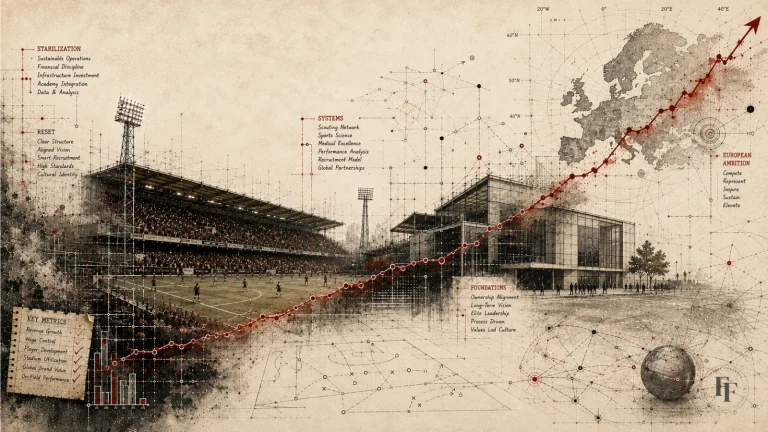
Armed with a modernized sporting model, Sunderland approached their Premier League return with clarity and purpose. The contrast in execution was immediate. Where their previous top-flight campaign in 2016/17 went winless through its first ten matches, the opening stretch of 2025/26 yielded five victories and three draws. A convincing 3-0 home victory against West Ham on opening day set the tone for a campaign defined by structure rather than survival instinct.
Central to this revival was an astute recruitment policy designed to balance proven top-tier authority with energetic tactical fits, underwritten by smart financial management. The high-profile sale of Jobe Bellingham provided the capital required to build genuine squad depth across multiple positions, allowing the club to navigate a demanding calendar. The marquee signing of veteran midfielder Granit Xhaka brought indispensable leadership and positional discipline to the central pivot, giving the squad an instant tactical anchor. Up front, retaining Wilson Isidor alongside the addition of Brian Brobbey created a multi-dimensional attack capable of stretching lines and overpowering physical center-backs.
Defensive solidity remained the ultimate cornerstone of the project. The arrival of 23-year-old goalkeeper Robin Roefs from NEC Nijmegen provided an imposing presence between the posts, resulting in 10 clean sheets in his debut campaign. Backed by the fourth-best defensive record in the Premier League with just 48 goals conceded, trailing only Arsenal, Manchester City, and Brighton, Sunderland built a foundation that was virtually impossible to break down.
By finishing seventh in the league and pipping Brighton by a single point on the final day, Sunderland did far more than avoid the standard promoted team battle for survival. They secured qualification for the UEFA Europa League, completing one of the most remarkable single-season turnarounds in modern top-flight history.
The Next Horizon
Sunderland’s resurgence stands as a testament to the power of tactical clarity, structural patience, and institutional resolve. From the depths of a double relegation to the European stage, the club has re-established its historic identity through hard work and disciplined execution. Whether this achievement represents a brief moment of magic or the foundation of a permanent power shift in English football, Sunderland has proven that the distance between rock bottom and the top tier can be bridged when a clear, unshakeable philosophy guides every step forward. As Régis Le Bris remarked during his arrival, setting the tone for their sporting renaissance:
“We will not play like Guardiola or De Zerbi, because we are Sunderland and I am Régis Le Bris.”
— Régis Le Bris
(Un)laced
A curated look at the moments that mattered alongside stories and insights worth your time.